
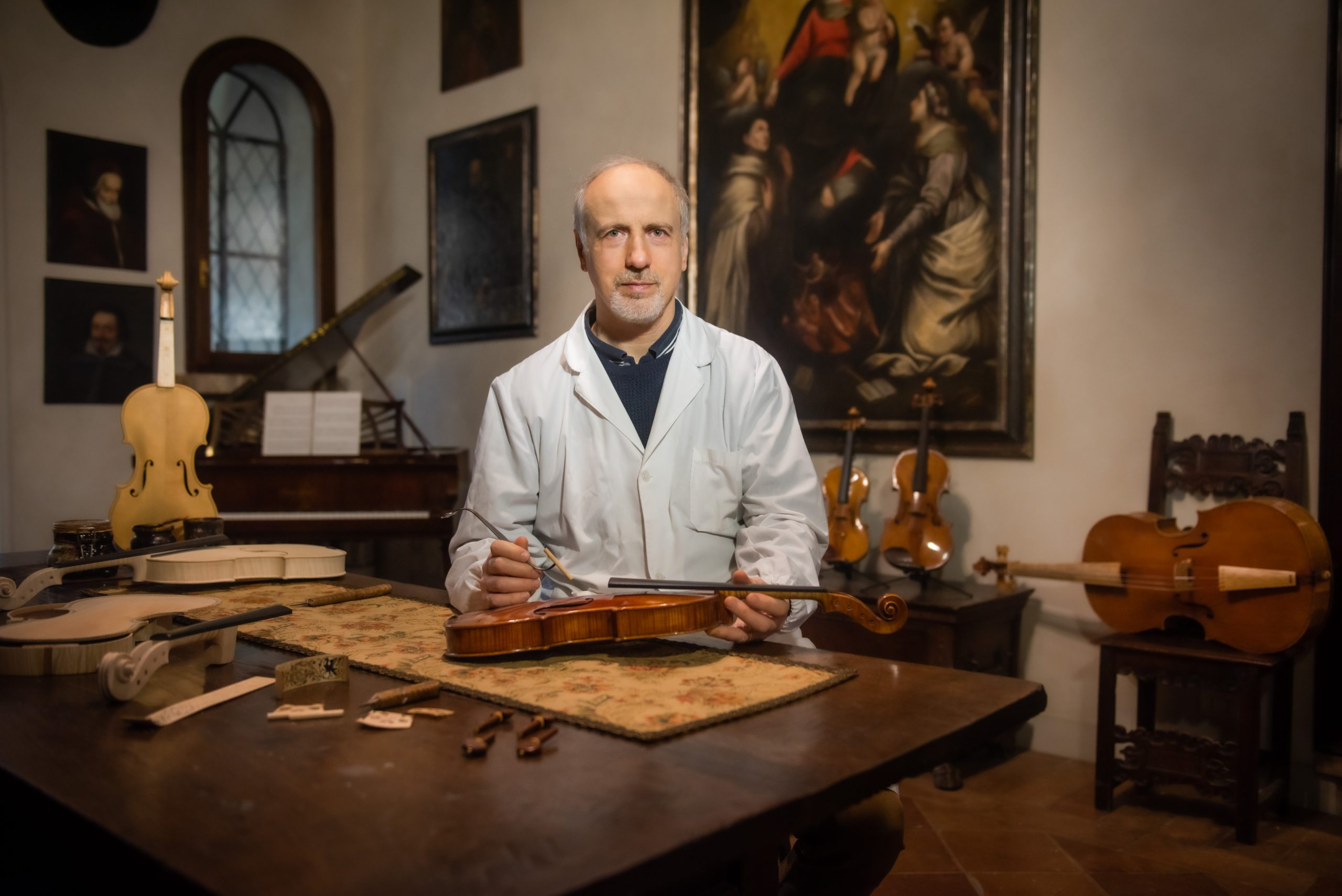
MV Cremona nasce da un mestiere, non da un piano industriale. Il suo fondatore non è un discografico: è un liutaio.
Marcello Villa arriva a Cremona da ragazzo, spinto da un consiglio ricevuto in prima media: se ami il violino, qui c'è la scuola giusta. Si iscrive alla Scuola di Liuteria, scopre di avere mano per il legno, e nel 1986 apre la sua prima bottega in via Aselli. Dieci anni dopo si trasferisce in via San Giuseppe, dove lavora tuttora.
Ma costruire violini non gli basta. Fra le mani di un liutaio passano continuamente spartiti, cataloghi, nomi di compositori dimenticati — e Villa si accorge che moltissima musica scritta nei secoli passati non è mai stata registrata, né forse mai più eseguita dopo la sua epoca. Nel 1999, insieme al giovane violinista Andrea Rognoni, decide di rimediare: nasce MV Cremona, e il primo disco è dedicato a Gasparo Visconti, nobile e violinista cremonese fra Seicento e Settecento, le cui sonate erano rimaste silenti per quasi trecento anni.
Da allora il metodo non è cambiato. Il lavoro comincia negli archivi, quasi more filologico: si cercano le fonti, si verificano le attribuzioni, si sceglie lo strumento storico o la replica fedele più adatta a restituire il suono per cui quella musica fu scritta. Non è un caso se nel catalogo compaiono così spesso organi d'epoca, violini e chitarre di liuteria antica — anche se, va detto, raramente sono proprio gli strumenti di Villa a suonare: l'etichetta non è mai stata pensata come vetrina della sua bottega.
Oggi MV Cremona conta decine di incisioni, richieste da appassionati e istituzioni in tutto il mondo — spesso introvabili altrove, per via delle tirature limitate. Resta un progetto piccolo per scelta, guidato dalla stessa curiosità che lo ha fatto nascere: dare di nuovo voce a musica che rischiava di restare silenziosa per sempre.
MV Cremona grew out of a craft, not a business plan. Its founder is not a record producer: he is a violin maker.
Marcello Villa came to Cremona as a boy, following a piece of advice he received in his first year of middle school: if you love the violin, this is where you will find the right school. He enrolled at the International School of Violin Making, discovered a natural aptitude for woodworking, and in 1986 opened his first workshop in Via Aselli. Ten years later he moved to Via San Giuseppe, where he still works today.
But making violins was not enough. Scores, catalogues and the names of forgotten composers constantly pass through the hands of a violin maker, and Villa began to realise that a vast amount of music written in past centuries had never been recorded, and perhaps had never even been performed again after its own time. In 1999, together with the young violinist Andrea Rognoni, he decided to do something about it: MV Cremona was born. Its first recording was devoted to Gasparo Visconti, a Cremonese nobleman and violinist active between the seventeenth and eighteenth centuries, whose sonatas had remained silent for almost three hundred years.
The method has remained unchanged ever since. The work begins in the archives, with an almost philological approach: sources are traced, attributions verified, and the historical instrument—or the most faithful replica—is selected in order to recreate as closely as possible the sound for which the music was originally conceived. It is therefore no coincidence that period organs, violins and historic guitars appear so frequently in the catalogue. It should be noted, however, that Villa's own instruments are rarely the ones heard on the recordings: the label was never conceived as a showcase for his workshop.
Today MV Cremona has released dozens of recordings, sought after by enthusiasts and institutions around the world and often difficult to find elsewhere because of their limited print runs. It remains deliberately small in scale, guided by the same curiosity that inspired its creation: to give a voice once again to music that might otherwise have remained silent forever.